
INTRODUCTION
2026 is a year in which the games market keeps growing, yet capturing a share of that growth is getting harder. Mobile games once again account for the largest portion of global revenue; however, rising player acquisition costs, revenue models and retention periods now directly determine companies’ commercial performance. While game studios originating from Türkiye continue to attract the interest of international investors, generative AI tools that have become embedded in game development processes are turning intellectual property and licensing into critical issues.
1. The Global Games Market Is Growing, but Platform Dynamics Are Diverging
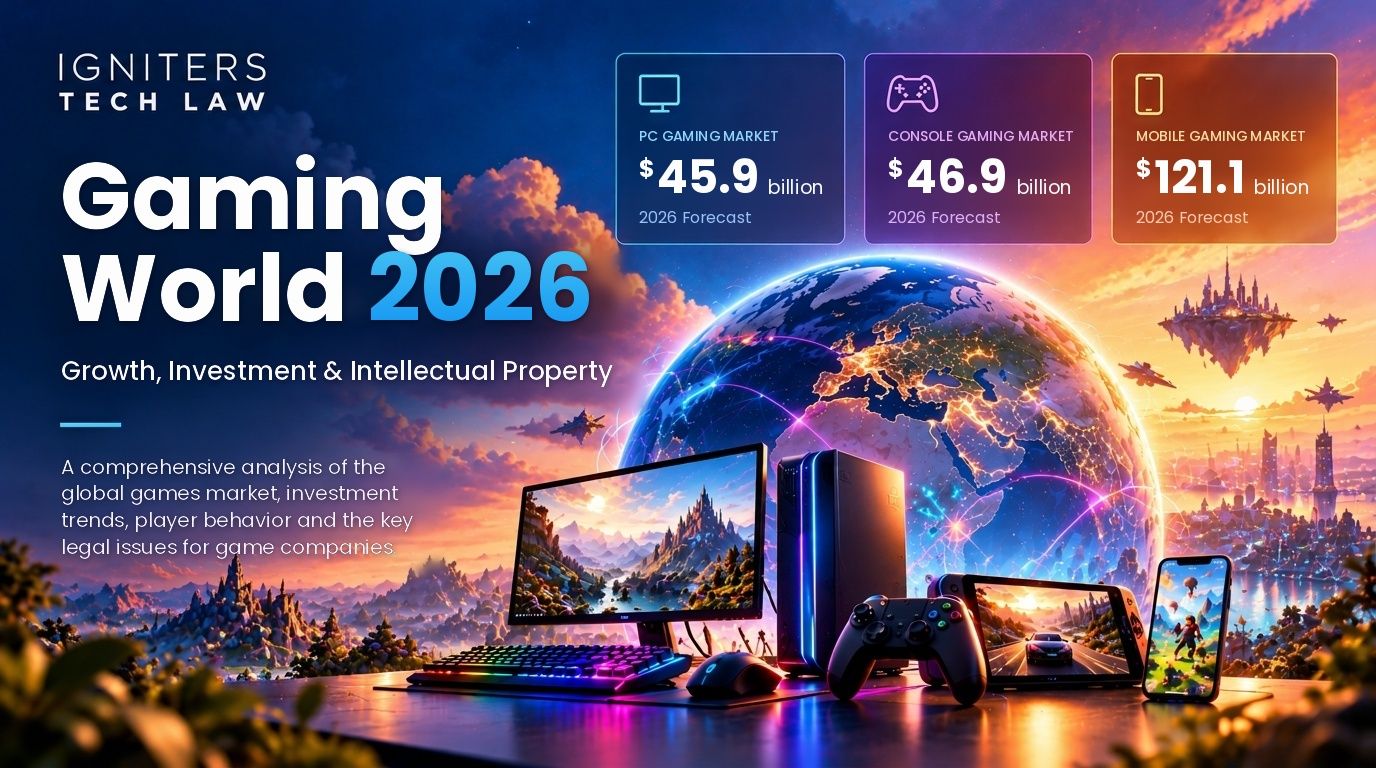
According to Newzoo’s 2026 projections, the global games market is expected to close the year at USD 213.9 billion, with growth of 6.1%. In terms of revenue distribution, mobile games are expected to retain first place with USD 121.1 billion, while console games are projected to reach USD 46.9 billion and PC games USD 45.9 billion. [1]
Figure 1 — 2026 Global Games Market Revenue Distribution (USD Billion / Total: USD 213.9B)
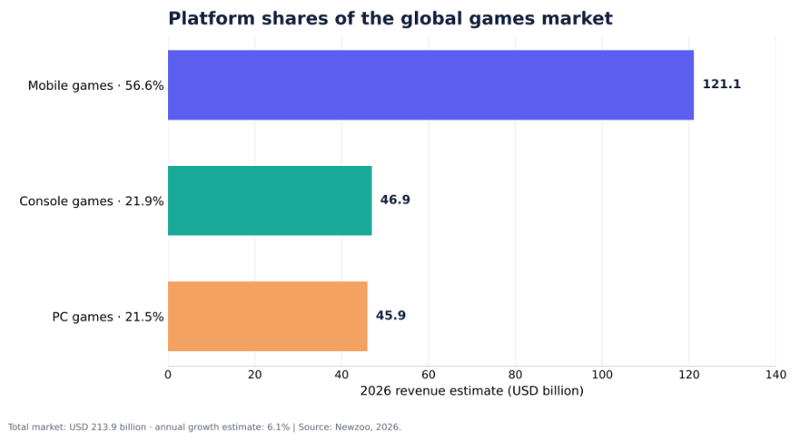
Source: Newzoo (2026 Global Games Market). [1]
Although mobile games make up more than half of the total market, revenue mechanisms differ significantly across platforms. On mobile, in-app purchases and advertising revenue form the backbone; on PC and console, full-game sales, subscription systems and in-game spending work together. Because of this structural difference, a revenue model that works on one platform often cannot be transferred directly to another. [1]
2. Downloads Alone Are Not Enough in Mobile Games
According to the 2024–2025 global gaming app data in Adjust’s 2026 Gaming App Insights report, cost per install (CPI) rose 30% year on year in 2025 to USD 0.56. According to a PocketGamer.biz article citing Newzoo’s 2026 Global Games Market report, global mobile game downloads fell 25% year on year in the first half of 2026. Sensor Tower’s H1 2026 Gaming Digital Market Index, meanwhile, reported global mobile game downloads of 24 billion, a 12% year-on-year decline. The 25% decline PocketGamer.biz cites from Newzoo and the 12% decline reported by Sensor Tower rest on different research scopes and methodologies; the two figures should not be treated as directly comparable and should each be assessed within the framework of their own source. [2] [3] [4]
In free-to-play games, high download numbers no longer signal commercial success on their own. How often players return to the game, how active they remain inside it, how much revenue they generate through ads and in-app purchases, and what the player’s lifetime value (LTV) is are now the truly decisive metrics. As user acquisition costs rise, retaining existing players and extending a game’s revenue life are becoming priorities for studios. [1] [3]
3. The Türkiye Games Ecosystem: Capital Continues to Flow
In 2026, Türkiye-linked game companies continued to secure financing in both early-stage and later-stage investment rounds. The table below includes selected transactions that have been publicly announced and can be verified through sources; it is not the total of all investments in the Turkish games sector. [5] [6]
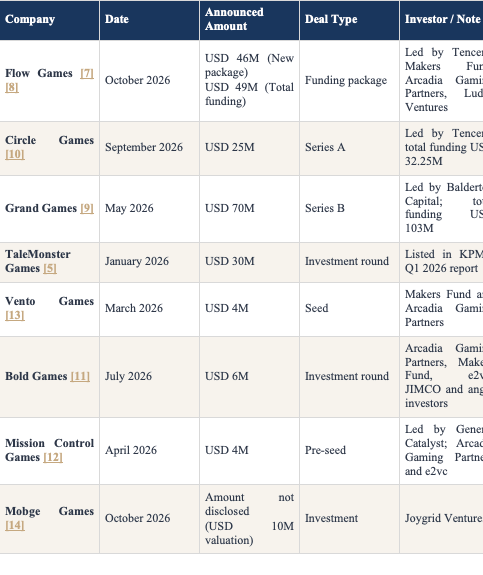
Figure 2 — Selected Funding Deals in 2026 (USD Million)
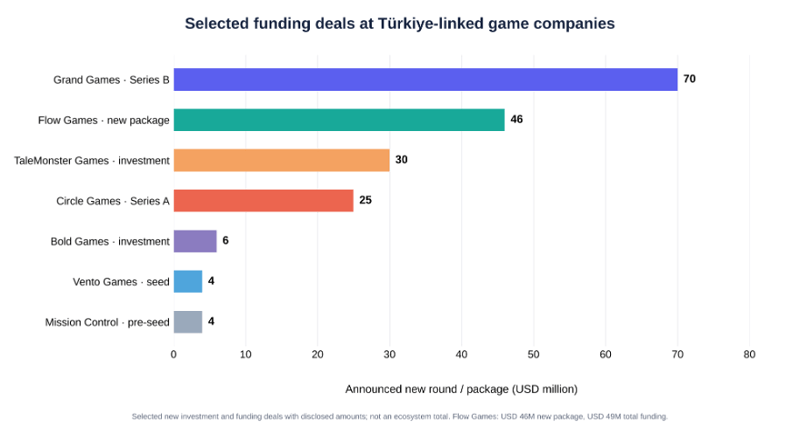
Note: The comparison is based only on new investment and financing deals with disclosed amounts. Deals with undisclosed amounts or for which only a valuation was reported, as well as acquisitions (M&A), are not included in the total of new funding rounds. [5] [14]
When reading financial data, it is necessary to distinguish between concepts:
● Flow Games: On 13 October 2026, the company was reported to have received a new USD 46 million funding package; on 16 October, the company confirmed that its total funding, including previous rounds, stood at USD 49 million. Separately, according to a PocketGamer.biz article based on AppMagic estimates, the studio’s game Smash Fest! received over 2 million downloads in June and reached 10.2 million downloads in July. While this data confirms strong download momentum, on its own it is not proof of revenue or profitability; indeed, the same source highlights the importance of advertising revenue alongside in-game spending. [6] [7] [8]
● Growth and Early-Stage Rounds: Circle Games raised a USD 25 million Series A led by Tencent in September, while Grand Games brought its total funding to USD 103 million with a USD 70 million Series B round. Investments received at various stages by studios such as TaleMonster, Vento, Bold and Mission Control show that demand for both scaling capital and new product development capital continues in the Turkish ecosystem. [5] [9] [10] [11] [12] [13]
● Distinguishing Acquisitions from Investments: According to KPMG’s Q1 2026 report, total deal volume in Türkiye’s startup ecosystem reached USD 559.2 million across 42 deals. Of this, USD 509.2 million came from six acquisition (M&A) deals. Excluding all six acquisitions, seed, early-stage and later-stage investment volume amounts to USD 50 million. This figure is not specific to the games sector; it covers Türkiye’s entire startup ecosystem. Assessing acquisitions separately from standard investment rounds ensures that investment data is read correctly. [5]
4. Player Profile: Age, Gender, Platform and Spending Behavior
Total market size alone is not enough to explain player behavior. To see which audience companies can reach, and through which distribution channel and revenue model, age, gender, device preference and payment habits need to be read together. That said, since the US, European and Turkish studies use different age ranges and measurement methods, the data below should be treated as regional indicators rather than one-to-one comparable results of a single survey. [15] [16] [17] [19]
United States: An Adult-Weighted, Cross-Generational Market
According to the ESA’s 2026 report, 212.3 million people aged 5–90 in the US (67% of the relevant population) play video games for at least one hour a week. In a market where the average player age is 37, the gender split is 53% male and 46% female. The weekly play rate is above 80% among Gen Alpha and Gen Z, while it stands at 71% for Millennials, 56% for Gen X and 50% for the 62–80 age group. The data clearly confirms that the games market is not confined to a young audience or a single gender. [15]
Europe: Mobile Leads in Reach, 91% of Revenue Is Digital
According to GameTrack data from Video Games Europe and EGDF covering 16 countries, published in 2026 (2025 data), there are 199 million players aged 6–75 in Europe (51% of the relevant population). 77% of players are adults, 46% are women and the average age is 34. In terms of device preference, 82% of players say they play on a smartphone or tablet, 47% on a console and 34% on a computer. In Europe, 91% of games revenue comes from digital and 9% from physical sales; in the device-based revenue split, mobile accounts for 49%, console 30% and PC 12%. [16]
Figure 3 — Platform-Based Reach and Revenue Comparison in the European Market
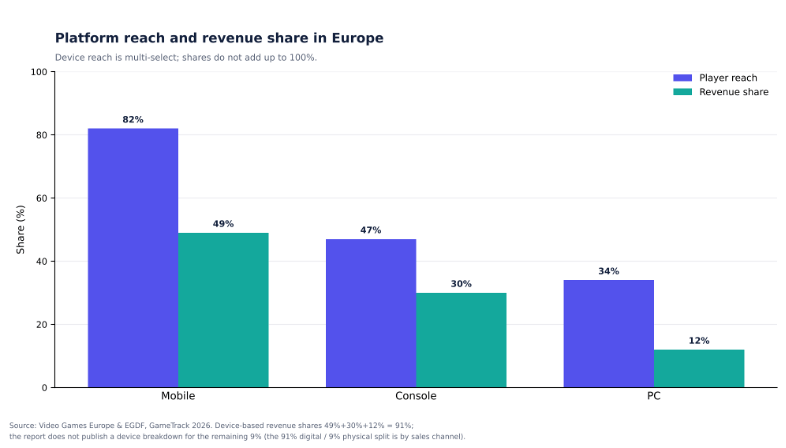
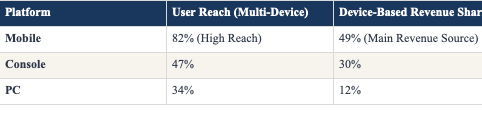
Source: Video Games Europe & EGDF (GameTrack 2026). [16]
Note: Device-based revenue shares add up to 91%; the report does not publish a separate device breakdown for the remaining 9%. The 91% digital / 9% physical split is a separate presentation based on sales channel. [16]
Türkiye: Broad Mobile Reach and a Distributed Spending Structure
According to Gaming in Türkiye’s 2025 report, there are approximately 50 million active players in Türkiye, 54% male and 46% female. The report’s platform-based estimates correspond to player pools of 47 million on mobile, 22 million on PC and 12 million on console. The publisher presents these platform breakdowns as estimates; since the same person may be counted on more than one platform, the values cannot be added together to obtain a unique player count. The official download page of the original report and an accessible copy of the report are provided in the references. [17]
Payment Behavior in Türkiye: Oyunfor September 2026 Data
Although not a representative average of all spending across Türkiye, Oyunfor’s own platform sales data for September 2026 offers a concrete snapshot of local payment trends. 57% of game and digital content purchases on the platform come from the 21–30 age group, 38% from users over 30, and 5% from the 18–21 age group. Because the age ranges in Oyunfor’s published platform data overlap (18–21, 21–30, 30+) and the measurement denominator (whether number of transactions or revenue) has not been clarified, these ratios should be read as a platform-specific trend snapshot rather than a definitive indicator for Türkiye as a whole. 41% of purchases are in the mobile category, 33% in PC and 26% in console, while 55% of purchases are made by male users and 45% by female users. In the same period, the titles leading the platform’s in-game sales were Counter-Strike 2, PUBG Mobile, Valorant, Free Fire and League of Legends. [18]
Figure 4 — Oyunfor September 2026 Purchase Breakdown
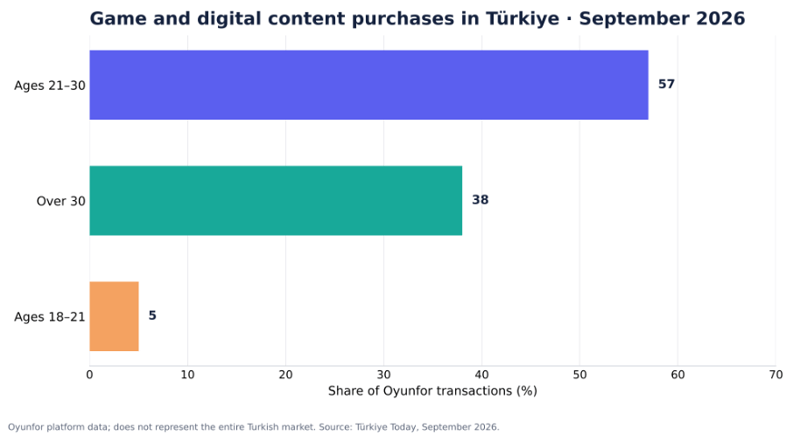
Source: Oyunfor (September 2026, Türkiye Today). [18]
Gender and Platform Preferences: Newzoo Analysis
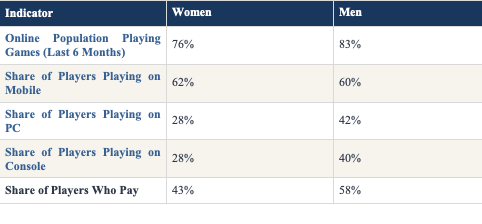
According to Newzoo’s 2025 Global Gamer Study analysis covering 36 markets, among the online population aged 10–65, the share who said they had played games in the last six months is 76% for women and 83% for men. Device usage rates show the share among players: on mobile, 62% of women and 60% of men; on console, 28% of women and 40% of men; on PC, 28% of women and 42% of men. The share of players who reported spending money on games is 43% for women and 58% for men. For this reason, the rates in the first row should not be read on the same denominator as the device and payment rows. The data shows that device preferences and payment behavior differ between female and male players. [19]
Figure 5 — Device Preference and Payment Rates by Gender (Global)
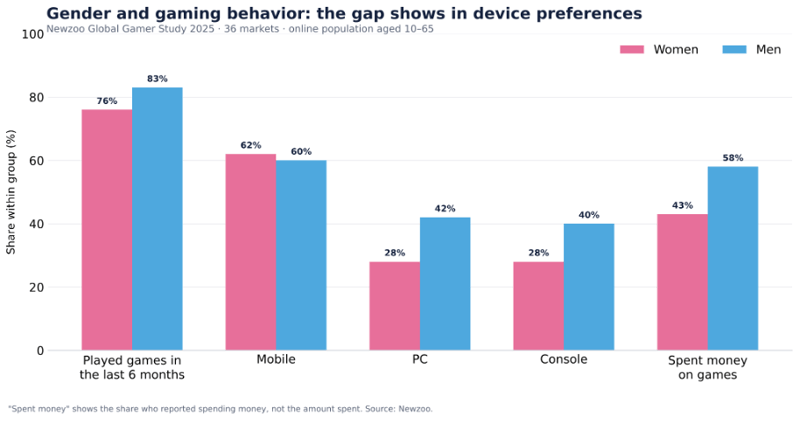
Source: Newzoo (2025 Global Gamer Study). [19]
Commercial Takeaways
Demographic and behavioral data lead to three practical conclusions for game companies: [15] [16] [17] [19]
1. Mobile Reach and Revenue Balance: Although mobile provides the widest user reach, the revenue model varies between advertising, in-app purchases or direct sales depending on the country and the game’s genre. [1] [16]
2. Revenue Diversity of PC and Console: Although the PC and console audience is narrower than mobile in terms of reach, it offers multi-channel revenue opportunities through paid full games, downloadable content (DLC), subscriptions and in-game spending. [1] [16]
3. Metric-Driven Strategy: Age and gender data alone are not sufficient to build a marketing strategy. Companies need to measure user acquisition cost (CPI), retention rate, paying user rate, average revenue per user (ARPU) and lifetime value (LTV) together in the target market. [3] [19]
5. Generative AI and Game Development Processes
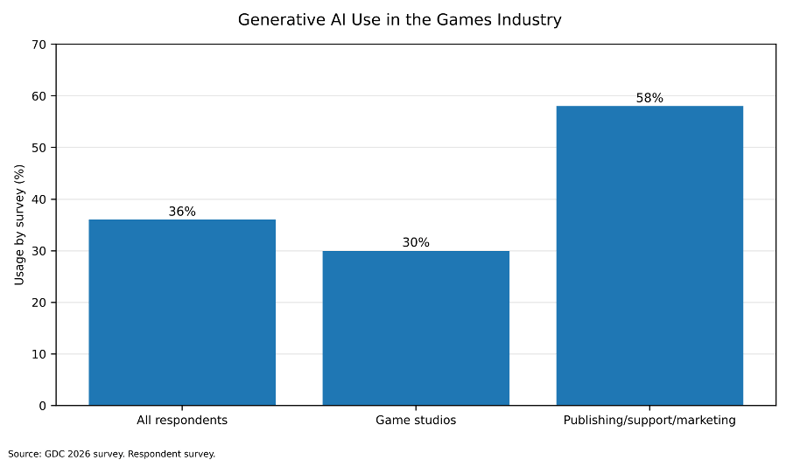
According to GDC’s 2026 industry survey, 36% of responding professionals use generative AI tools in their work processes. This rate, 30% at studios that develop games directly, rises to 58% at publishing, support and marketing companies. The tools are used most in research and ideation, routine tasks, code assistance and prototyping. [20]
Figure 6 — Generative AI Usage Rates by Industry Segment
Source: GDC (2026 State of the Game Industry). [20]
Use Cases in Game Production and Türkiye Data
In the international Cint survey of 300 game developers conducted in 2025 and included in Unity’s 2026 Game Development Report, respondents who implement AI reported using it most for coding assistance (62%), writing and narrative design (44%), NPC behavior (40%), market research (37%), and automated game testing and concept art or game asset creation (35%). These rates show the areas in which AI is used in game projects; they do not measure the market for tools designed solely for game production. [22]
Data for Türkiye is more limited. A study by Bütün and Uçan published in 2025 measured the acceptance of generative AI among 81 participants active in the digital game design process. The study reported an overall mean acceptance score of 3.82 out of 5. This finding is not a usage prevalence rate and cannot be generalized to the entire games sector in Türkiye. [23]
That said, producing content faster or in greater volume does not directly translate into a higher-quality game or higher commercial revenue. Testing the generated content, fixing technical bugs, establishing game balance and improving the player experience still require human effort and expertise. Studios need to calculate, based on this holistic picture, to what extent AI tools actually reduce total production time and cost.
6. Legal Checklist for Game Companies and Investors
Before sitting down at the investment or acquisition table, both studios and investors should verify the following six key questions with supporting documentation:
1. Ownership of Rights: Are the rights to the game’s source code, visuals, music, characters and story owned directly by the company, or are they used under license?
2. AI and Third-Party Tools: What commercial license terms govern the third-party intellectual property and generative AI tools used in the production process?
3. Contract Chain: Do the contracts with employees, freelancers and external developers provide for the transfer of economic rights to the company clearly and in compliance with FSEK (the Turkish Law on Intellectual and Artistic Works)?
4. Distribution and Platform Terms: On which stores and platforms can the game be published, and how do platform agreements affect the game’s revenue model?
5. Data and Regulation: What legal obligations arise from the processing of user data, advertising technologies (AdTech) and in-game purchase mechanics?
6. Transferability: Prior to an investment or share transfer, can the continuity of the company’s intellectual property portfolio and commercial contracts be documented without gaps?
Conclusion
In 2026, while the games sector continues to grow, the criteria for commercial success are changing markedly. The widening gap between downloads and revenue in mobile games is bringing to the fore game designs that can retain users and generate long-term revenue. While investment rounds and acquisitions in Türkiye strengthen domestic studios’ position in the global market, the spread of AI tools is making new legal standards on copyright and content ownership a necessity.
In today’s market conditions, a game company’s long-term value is determined not only by the quality of the game but also by the sustainability of its revenue model, the right target audience and distribution strategy, the strength of its intellectual property portfolio and a well-designed contract structure. For developers and investors, the real competitive advantage lies in being able to plan these commercial and legal elements together while the game is still in development.
Editorial Note
This report was prepared based on publicly available sources as of 26 October 2026. Global market figures are estimates by research firms. The Türkiye investment table covers selected deals whose amounts and deal types were disclosed in the sources; it is not a complete total for the sector. The legal assessments are for general information purposes only, and separate legal advice should be obtained for specific transactions. [1] [5]
REFERENCES
Global Market and Mobile Data
[1] Newzoo — 2026 Global Games Market — https://newzoo.com/articles/2026-global-games-market-key-numbers
[2] PocketGamer.biz — No “single model” for growth, says Newzoo — https://www.pocketgamer.biz/no-single-model-for-growth-says-newzoo/
[3] Adjust — The gaming app insights report: 2026 edition — Official report page: https://www.adjust.com/resources/ebooks/gaming-app-insights/ | Accessible copy of the report text (CPI data, p. 28): https://investgame.net/news/pdf/2026-03-26-gaming-app-insights-report-2026_wp/ | https://www.adjust.com/blog/gaming-app-insights-2026/
[4] Sensor Tower — H1 2026 Gaming Digital Market Index — https://sensortower.com/blog/h1-2026-digital-gaming-market-index
Türkiye Investment and Ecosystem Data
[5] KPMG Türkiye — Türkiye Startup Investments 2026, Q1 — https://kpmg.com/tr/tr/insights/2026/06/turkiye-startup-yatirimlari-2026.html
[6] InvestGame — Weekly Digest 42 (Flow Games and games investments in Türkiye) — https://investgame.net/news/digest/42-2026/
[7] PocketGamer.biz — Flow Games’ USD 46 million funding package and Smash Fest! data — https://www.pocketgamer.biz/exclusive-turkish-developer-flow-games-raises-46m-in-funding-package-led-by-tencent/
[8] PocketGamer.biz — Flow Games’ announcement of USD 49 million in total funding — https://www.pocketgamer.biz/flow-games-confirms-49m-in-total-funding-from-tencent-and-vc-investors/
[9] Balderton Capital — Grand Games Series B — https://www.balderton.com/news/grand-games-raises-70m-series-b/
[10] PocketGamer.biz — Circle Games Series A — https://www.pocketgamer.biz/circle-games-raises-25m-in-series-a-led-by-tencent/
[11] PocketGamer.biz — Bold Games investment — https://www.pocketgamer.biz/exclusive-trkiye-studio-bold-games-raises-6m/
[12] PocketGamer.biz — Mission Control Games investment — https://www.pocketgamer.biz/mission-control-games-launches-with-4m-pre-seed-to-rethink-casual-puzzle-design/
[13] PocketGamer.biz — Vento Games seed investment — https://www.pocketgamer.biz/istanbul-based-vento-games-secures-4m-to-scale-family-friendly-mobile-puzzle-portfolio/
[14] Mobidictum — Mobge Games and Joygrid Ventures investment (USD 10 million valuation) — https://mobidictum.com/mobge-games-joygrid-ventures-10m-valuation/
Player Profile, Demographics and Spending Data
[15] ESA — 2026 Essential Facts About the U.S. Video Game Industry — https://www.theesa.com/two-thirds-of-americans-play-video-games-every-week-according-tonew-report-from-the-entertainment-software-association/
[16] Video Games Europe & EGDF — All About Video Games: European Key Facts 2025 — https://www.videogameseurope.eu/publication/2025-all-about-video-games-european-key-facts/
[17] Gaming in Türkiye — Türkiye Game Market Report 2025 — Official report page: https://www.turkiyeoyunsektoruraporu.com/en/ | Accessible copy of the report: https://www.scribd.com/document/1030325351/Tu-rkiye-Oyun-Sektoru-Raporu-2025
[18] Türkiye Today — Oyunfor’s September 2026 game and digital content purchases — https://www.turkiyetoday.com/lifestyle/turkiye-gaming-market-remains-driven-by-21-30-age-group-as-cs2-tops-september-spendin-3229838
[19] Newzoo — 3 in 4 women play games, but discovery and spending patterns differ — https://newzoo.com/articles/women-play-games-discovery-spending
AI and Legal Sources
[20] GDC — 2026 State of the Game Industry — https://gdconf.com/article/gdc-2026-state-of-the-game-industry-reveals-impact-of-layoffs-generative-ai-and-more/
[21] Mevzuat.gov.tr — Law on Intellectual and Artistic Works (Law No. 5846) — https://www.mevzuat.gov.tr/mevzuatmetin/1.3.5846.pdf
[22] Unity — 2026 Game Development Report (Cint survey, 300 developers) — https://unity.com/resources/gaming-report
[23] Bütün & Uçan — A Descriptive Analysis of Digital Game Designers’ Acceptance Levels Toward Generative AI — AVESİS: https://yildiz.edu.tr | Symposium Paper: https://beykent.edu.tr